Thursday, March 12, 2020

Okinawa

Once we knew that we had two and a half weeks in Japan, we took turns picking locations to visit but we both had Okinawa on our list, so it was an easy choice for the last several days. We were not entirely sure what to expect, and did little research in order to be pleasantly surprised when we arrived, but found it to be a beautiful island(s) and an interesting place socially.

We found the significance presence of American military personnel and their families, along with the years that Okinawa was under American sovereignty after the war, has resulted in a fascinating American/Japanese fusion hat is influenced by Okinawa's own historical culture.  One nice perk of this was the prevalence of English, it was much easier to find signs in English and people who spoke at least a bit of the language (except for the elderly taxi driver we had one day who spoke no English and was asking me to direct him to our destination, never mind that I was a foreigner haha). We lost track of how many McDonald's we found, but were amused at how some of them played honky tonk country music. The weather was a delightful treat after the more wintery temperatures of the US and our time on the mainland Japan. With daytime reading upper 70s or low 80s, we were comfortable in shorts and t-shirts; the locals in long sleeves and coats informed us it was far too cold for such summer wear, as they routinely have 100+ degrees during the summer months.


Te spelling wasn't necessarily better despite
more English speakers...


American Village was a fun part of to explore that was easy walking distance from our hotel. It featured a giant Ferris wheel, American restaurants, shopping, a beach side boardwalk and an arcade. It was constructed as a theme park several decades ago as a way for Americans stationed on the island to feel more at home.

View from the top of the Ferris wheel


I didn't say the American food they offered was good :D 
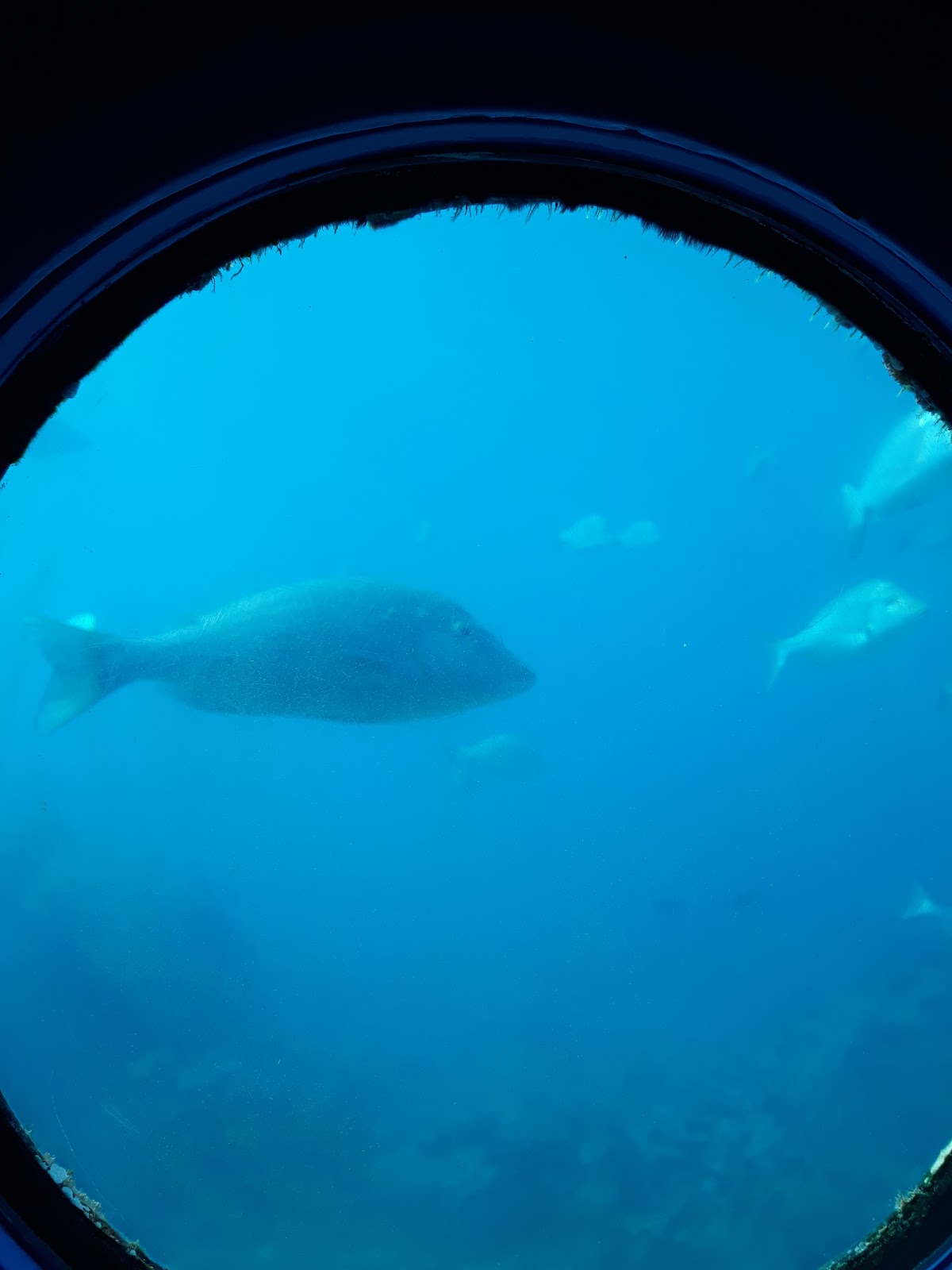
A bus tour booked for one day of our stay took us to the Northern part of the island (the day of the tour we got a call at 830 am that the scheduled 930 departure was running 20 minutes ahead of schedule so to be at the pick-up early....we had to run 12 blocks to get there in time. Only in Japan!). We got to cross the stunning bridge over to Love Island, called such due to a folk tale along the lines of the Adam and Eve story, that homo sapiens were conceived there. Beautiful place in this world so might not be too far-fetched, ha! The afternoon was spent at the Chura-umi aquarium, a fantastic place with an incredible assortment of sea creatures, including sperm whales and manta rays. My favorite part of the tour was the underwater observatory at a coral reef. We got to descend five meters under the under where we had 360 degree views of coral reef and all the beautiful fishies and creatures that live there.

View from the Love Island bridge


Okinawan ice cream on the island


Smallest of the sperm whales


One afternoon we decided to rent bikes, since public transportation was much less reliable and available than mainland Japan. One of the sites we visited on our bike journey was the underground tunnel system used by the Okinawan navy during WWII. As the American forces came closer to invading the islands, the Navy bunkered down in a system of tunnels they dug out to try and outlast the battles. It was a sad place to visit when considering the hardships endured by military and civilians alike and the high number of casualties. But we also appreciated the opportunity to view and learn about the history from an alternate perspective.
Generals uniform

Stairs down to the tunnels (lighting is not original)

This was one of the bigger tunnels

Map of the tunnel system


Generals quarters
Our final day on the island had a chunk of free time between hotel check out and getting to the airport. Due to needing to manage luggage, and running a little short on energy and cash we decided on something low-key to pass the time. Fortunately, downtown Naha city did not let us down. After enjoying an early lunch at an all-you-can-eat shabu-shabu restaurant, we spent the remainder of our time at a hedgehog cafe. They offered hamsters and gerbils, rabbits, mice and hedgehogs for you to meet and enjoy interacting with. Weird, but fun in an odd way haha.


Monday, March 09, 2020

Miyajima Island

Miyajima Island is one of my favorite places in the world. Not because I have spent lots of time there, or have the best of friends or family to visit there, or because any significant life events have occurred there. I have spent all of two half days there, one several years ago and one while on our honeymoon trip around Japan. But it is a beautiful, peaceful place that somehow speaks to my inner Japanese adventurer and I would gladly return any time.

The island can be reached by a 5-minute ferry ride from the port of Hiroshima. We had the delight of taking a streetcar to the port so we could catch the ferry; riding a streetcar was a fun first for me.
Once you get to the island, there are loads of shrines and temples to be explored, stunning pagodas, and lots of "wild" deer. I put wild in quote marks because they tend to follow you around like dogs looking for a treat, but they are technically just part of the island wildlife.
The island is a very historic place, with one of the temples boasting of being one of the oldest sites of imperial spirituality, as the emperor has been known to travel there for prayer and rest. We also found a pagoda constructed by a Buddhist monk in the 12th century. To me, the island has a spiritual and very peaceful feel, perhaps because despite its proximity to Hiroshima, it seems to have escaped almost entirely unscathed during WWII.

Although I could keep describing my thoughts and perceptions, I think the pictures we got paint a much better picture so I will opt to share extra photos instead :)

Itsukushima Shrine, from the 12th Century


Senjokaku Pavilion, dedicated to the recitation of prayer

Tahoto Pagoda, one of the oldest on the island (couldn't find an exact date)

Buddhas with their winter hats on


Daisho-In, Buddhist temple founded in 806


Torii gate just as you exit the ferry terminal


Thursday, March 05, 2020

Castles in Japan

Leading up to our trip, we had lots of conversations where we got asked what we planned to do in Japan. Other than eating lots of delicious and strange food, the only other certain item on the to-do list was to visit some castles. We managed to visit five castles on mainland Japan (four of which we were able to enter) and two castle ruin sites in Okinawa. They all had unique features and a different story to tell and we found they were often the highlight of that particular part of the country. We also thought a good future travel goal would be to return to Japan so we could visit all the ones we missed :)

The first castle we visited was Osaka-jo (Jo means castle in Japanese), one that had been on my "to-visit" list for quite awhile. We spent most of the day exploring the castle grounds and the building itself. The inside has been refurbished and modernized so it could be converted to a museum explaining the history of the the castle, the region and the samurai lords who were significant players in the castle's history. The grounds are beautiful, featuring a grove of fruit and native trees, a large shrine, a shopping mall (not entirely historically accurate....but convenient!) and intact walls/barricades for two of the three original moats (the third is no longer existing, the city seemingly built over top of it). This is one of the fanciest and most significant castles in Japan, featuring in the most important of the civil wars. Construction of the original structure began in 1583.
5 stories of castle delight :)


The biggest rock in the castle wall...how did they move this in the 1500s??

Samurai guiding the shrine

Next on our castle visits was Nijo-jo in Kyoto. This was an Imperial villa back in the day. Part of it was under renovation, but we were able to tour the Ninomaru Palace, which historically functioned as living quarters for the castle lord and his family, and featured rooms for receiving other lords, visitors, etc. The building was amazing, with the ceilings and walls all painted with a range of murals. Each room had a different theme, ranging from seasonal floral themes to animals and general nature scenes. The ceilings were carved, painted wood and walls were of wood or rice paper. Photos were not allowed inside due to the age of the murals, but we got some good snapshots of the outside. Fun fact: the tower in the southeast corner of the compound is an original structure, and is the only tower to have been visited by an emperor (seems as if they did not mingle with the troops much so going to a watch tower would not have been a priority). Construction of this castle begin in 1603.

The imperial entrance gate


The back gate

Okayama castle, completed in 1597, was one of our favorites because it was a bit off the beaten track so it was less busy and had less "modernization." Due to its dark exterior, it was nicknamed "Crow Castle." It was much smaller and less decorated than some of the others as it was more of a regional Lord's castle, rather than something that would be utilized by the imperial family. We were lucky in our timing of this visit, we were in the castle while they were offering free photo shoots in traditional garb in the castle lord's chamber! The castle overlooked Korakuen, a traditional Japanese garden that was built in 1700 by the castle lord. It was used for entertaining visitors to the castle and for relaxation of the castle inhabitants.
Korakuen walkway

Shrine in the garden

Castle view from the garden


The lord and lady of the castle!


Hiroshima castle is unique in that it was built on flat land in the midst of the city, rather than the  hilltop setting of most other castles. This castle is known as Carp Castle, was built in 1589, in a remarkably short time, especially since the location was not ideal for construction of such a large building and required a significant amount of wood to be transported to the area. The moats were constructed so that if the castle came under attack the outer areas could be flooded to provide additional challenges in gaining access to the castle. Although destroyed by the atomic bomb in 1945 a full reconstruction was completed using traditional building methods.
We got really good at castle selfies ha!


View from the top floor


Main gate and storage rooms
We visited the Kumamoto castle grounds, but due to major earthquake damage a few years ago the castle is under reconstruction and could not be entered. We did get to see one of the towers from a distance, and enjoyed visiting Kumamoto's biggest shrine.
Shrine entrance

The only tower still standing after the earthquake

In Okinawa, we visited the Urasoe and Iso castle ruins. Iso castle dates back to the 12 century. There was very little still there to view, but the thought of standing in such a historic place was pretty breathtaking.
Urasoe castle was the largest castle in Okinawa in the 14th century and served as the Imperial palace until Shuri castle was built. It was mostly destroyed during WWII, but there are reconstructed tombs for castle lords that can still be found on the castle grounds. The grounds are also part of the historical battle of Okinawa during WWII, which the movie 'Hacksaw Ridge' is based on. At the end of the castle park is a cemetery with a memorial to Okinawan and Japanese forces that perish in the Battle of Okinawa, a somber reminder of the sacrifice made on both sides.

Remnants of Iso castle wall

Lords tombs at Urasoe castle


Top of Hacksaw Ridge

Memorial for Japanese forces lost during the Battle of Okinawa